Supporting the community and bringing balance to people's lives.
Suicide Prevention
Everyone can help prevent suicide. Being prepared to recognize the signs of suicide and respond appropriately can save a life.
As a certified LivingWorks trainer, I provide evidence-based suicide prevention training programs that prepare participants for a variety of helping roles through engaging and practical learning experiences.
Indigenous people continue to experience disproportionately higher rates of suicide due to the ongoing impacts of colonization, systemic inequalities, and intergenerational trauma.
There are two LivingWorks training options designed to strengthen suicide prevention awareness, intervention skills, and community capacity.
Selecting the Right Training
To determine which workshop best meets the needs of your participants, consider the following questions:
- What helping role do you envision for participants?
Will participants primarily need to recognize warning signs and connect individuals to support, or will they require more advanced intervention skills?
- How do participants learn best?
Consider whether participants would benefit most from a shorter awareness-based workshop or a comprehensive skills-based training experience.
- How much time can participants commit?
Training options range from a half-day workshop to a two-day intensive intervention program.
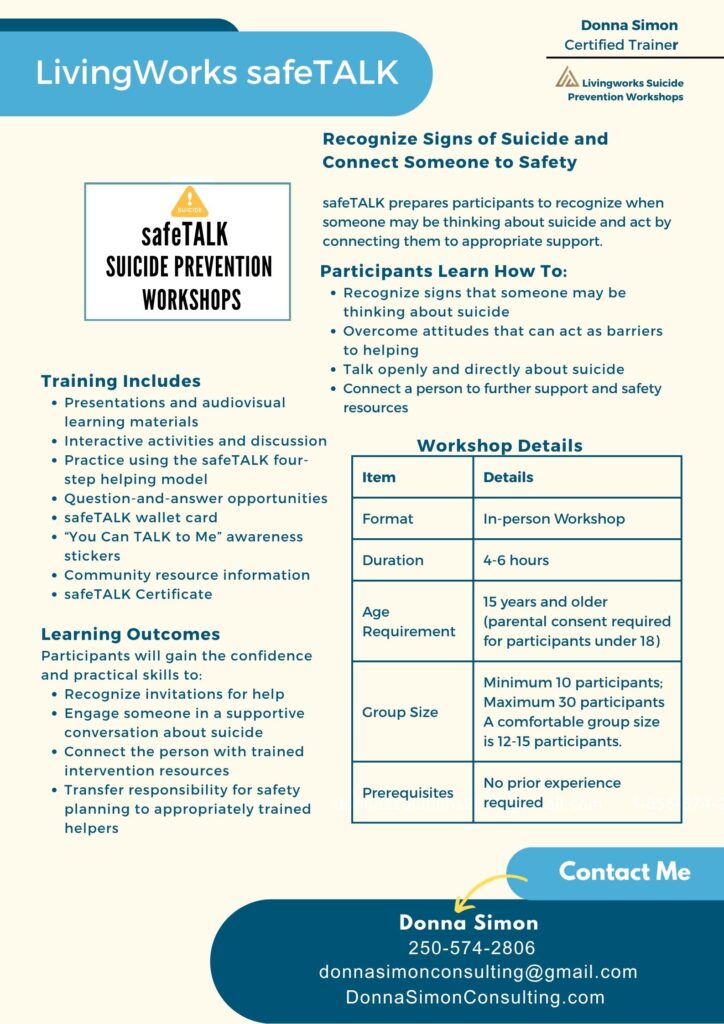
Training Option One – LivingWorks safeTALK
Recognize Signs of Suicide and Connect Someone to Safety
safeTALK prepares participants to recognize when someone may be thinking about suicide and act by connecting them to appropriate support.
Participants Learn How To:
- Recognize signs that someone may be thinking about suicide
- Overcome attitudes that can act as barriers to helping
- Talk openly and directly about suicide
- Connect a person to further support and safety resources
Workshop Details
Item | Details |
Format | In-person workshop |
Duration | 4–6 hours |
Age Requirement | 15 years and older (parental consent required for participants under 18) |
Group Size | Minimum 10 participants; Maximum 15 participants |
Prerequisites | No prior experience required |
Training Includes
- Presentations and audiovisual learning materials
- Interactive activities and discussion
- Practice using the safeTALK four-step helping model
- Question-and-answer opportunities
- safeTALK wallet card
- “You Can TALK to Me” awareness stickers
- Community resource information
- safeTALK Certificate
Learning Outcomes
Participants will gain the confidence and practical skills to:
- Recognize invitations for help
- Engage someone in a supportive conversation about suicide
- Connect the person with trained intervention resources
- Transfer responsibility for safety planning to appropriately trained helpers
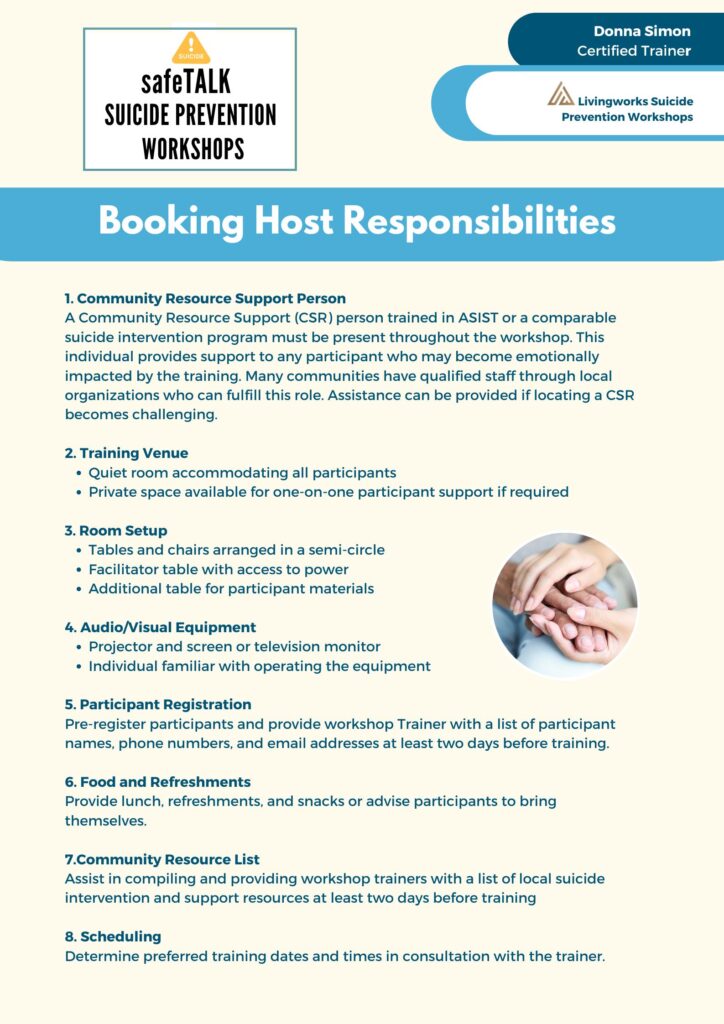
Booking Host Responsibilities – safeTALK
1. Community Resource Support Person
A Community Resource Support (CSR) person trained in ASIST or a comparable suicide intervention program must be present throughout the workshop.
This individual provides support to any participant who may become emotionally impacted by the training.
Many communities have qualified staff through local organizations, Métis Nation BC, or Métis Chartered Communities who can fulfill this role.
Assistance can be provided if locating a CSR becomes challenging.
2. Training Venue
- Quiet room accommodating up to 15 participants
- Private space available for one-on-one participant support if required
3. Room Setup
- Tables and chairs arranged in a semi-circle
- Facilitator table with access to power
- Additional table for participant materials
4. Audio/Visual Equipment
- Projector and screen or television monitor
- Individual familiar with operating the equipment
5. Participant Registration
Pre-register participants and provide workshop Trainer with a list of participant names, phone numbers, and email addresses at least two days before training to allow for certificate preparation and LivingWorks reporting requirements.
6. Food and Refreshments
Provide lunch, refreshments, and snacks or advise participants to bring themselves.
Assist in compiling and provide workshop trainers with a list of local suicide intervention and support resources at least two days before training
7. Scheduling
Determine preferred training dates and times in consultation with the trainer.

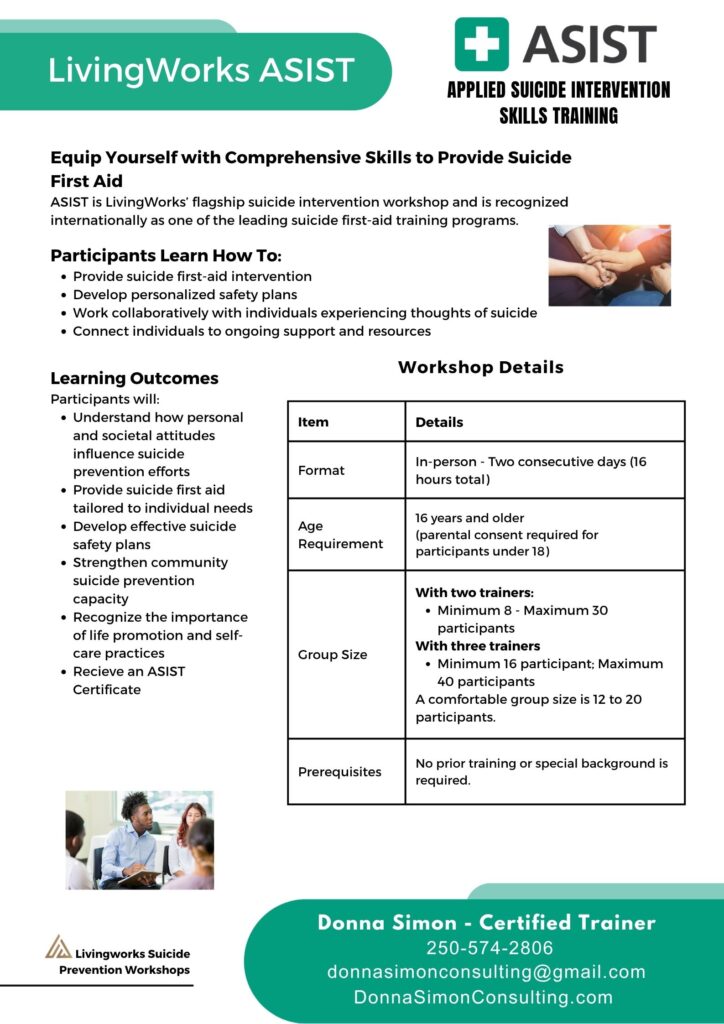
Training Option Two – LivingWorks ASIST
Applied Suicide Intervention Skills Training
Equip Yourself with Comprehensive Skills to Provide Suicide First Aid
ASIST is LivingWorks’ flagship suicide intervention workshop and is recognized internationally as one of the leading suicide first-aid training programs.
Participants Learn How To:
- Provide suicide first-aid intervention
- Develop personalized safety plans
- Work collaboratively with individuals experiencing thoughts of suicide
- Connect individuals to ongoing support and resources
Workshop Details
Item | Details |
Format | In-person |
Duration | Two consecutive days (16 hours total) |
Age Requirement | 16 years and older (parental consent required for participants under 18) |
Group Size | With two trainers: · Minimum 8 participants; Maximum 15 participants · Minimum 16 participants: Maximum 30 participants With three trainers · Minimum 16 participant; Maximum 40 participants On average a comfortable number of participants is 12 to 20 A large number of participants changes the dynamics of a group |
Facilitation | Two certified Living Works trainers to three (as above) |
Learning Outcomes
Participants will:
- Understand how personal and societal attitudes influence suicide prevention efforts
- Provide suicide first aid tailored to individual needs
- Develop effective suicide safety plans
- Strengthen community suicide prevention capacity
- Recognize the importance of life promotion and self-care practices
Prerequisites
No prior training or special background is required.
Many participants choose to complete safeTALK before attending ASIST, but this is not mandatory.
ASIST Training Features
- Small Group Learning
More than half of the workshop involves interactive group activities and skills practice.
- Multimedia Learning
High-quality videos, diagrams, and presentations reinforce key concepts.
- Experience-Based Learning
Participants build upon their existing personal and professional experiences.
- Proven Intervention Model
Activities are structured around the LivingWorks ASIST intervention model and include practical skill development.
- Individualized Approach
Participants learn how to adapt interventions to the unique circumstances and needs of the person seeking help.
- Self-Reflection
Participants explore personal attitudes toward suicide and helping, increasing self-awareness and effectiveness.
- Direct Communication Skills
Participants gain confidence discussing suicide openly, honestly, and directly.
- Cultural Adaptability
Certain workshop components can be tailored to meet cultural and professional needs, including Indigenous perspectives and community contexts.
- ASIST Certificate
No prior training or special background is required.
Many participants choose to complete safeTALK before attending ASIST, but this is not mandatory.
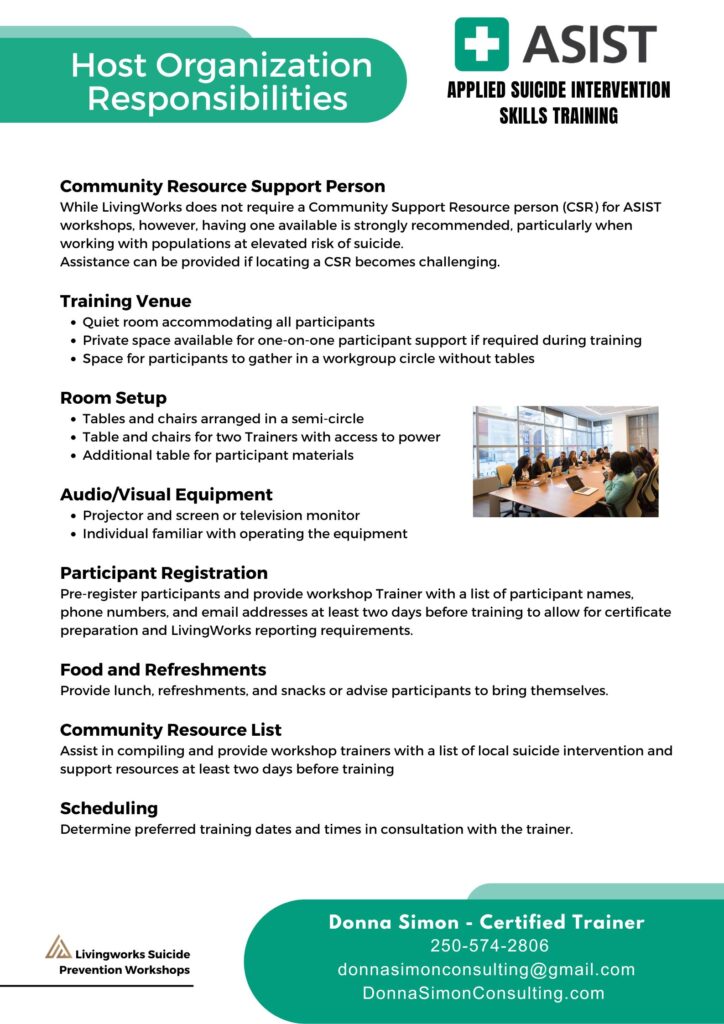
Host Organization Responsibilities – ASIST
1. Community Resource Support Person
While LivingWorks does not require a Community Support Resource person (CSR) for ASIST workshops, however, having one available is strongly recommended, particularly when working with populations at elevated risk of suicide.
If a CSR is not present one of the facilitators will need to leave the training to provide that support.
This individual provides support to any participant who may become emotionally impacted by the training.
Many communities have qualified staff through local organizations who may be available to fulfill this role.
Assistance can be provided if locating a CSR becomes challenging.
2. Training Venue
- Quiet room accommodating the chosen number of participants
- Private space available for one-on-one participant support if required during training
- Space for participants to gather in a workgroup circle without tables
3. Room Setup
- Tables and chairs arranged in a semi-circle
- Table and chairs for two Trainers with access to power
- Additional table for participant materials
4. Audio/Visual Equipment
- Projector and screen or television monitor
- Individual familiar with operating the equipment
5. Participant Registration
Pre-register participants and provide workshop Trainer with a list of participant names, phone numbers, and email addresses at least two days before training to allow for certificate preparation and LivingWorks reporting requirements.
6. Food and Refreshments
Provide lunch, refreshments, and snacks or advise participants to bring themselves
7. Community Resource List
Assist in compiling and provide workshop trainers with a list of local suicide intervention and support resources at least two days before training
8. Scheduling
Determine preferred training dates and times in consultation with the trainer. |
|
Suicide prevention is a shared responsibility, and communities are strengthened when individuals are prepared to recognize risk, offer support, and connect people to safety.
Both safeTALK and ASIST provide practical, evidence-based skills that can save lives and increase community capacity to respond to suicide-related concerns.
I welcome the opportunity to discuss these training options further and assist in selecting the program that best meets the needs of your community and participants.
Poster - LivingWorks safeTALK
Poster - Booking Host Responsibilities – safeTALK
Poster - LivingWorks ASIST
Poster - Host Organization Responsibilities – ASIST
Located in the Fraser Valley – Chilliwack B.C.
Reach out to book customized in-person or virtual presentations and workshops or to discuss your needs regardless where you live.
Email me at donnasimonconsulting@gmail.com
Or phone or text me at 250-574-2806